

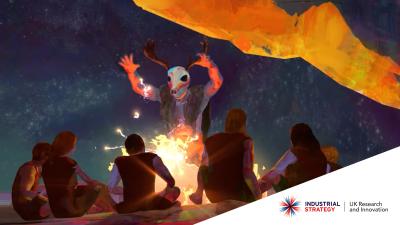
AR and VR: A Shared Experience
11th March 2019
Ever since the days when people sat around fires telling stories, us humans have loved shared storytelling. With advances in immersive technology…
Immersive technology - once considered an idea from the future, has gradually transformed from an abstract idea into a tangible reality.
It encompasses a range of technologies, from Virtual Reality to Augmented Reality, to sensory machines and immersive audio, all designed to fully engage every one of your senses. These technologies have now evolved into powerful tools with real-world applications across industries, from business to entertainment to education and healthcare.
In this blog, we'll explore the journey of immersive technology from its original concept to the latest versions, accessible to most today. You will be able to see how it conceptual roots to the cutting-edge innovations we're seeing today, and how it's reshaping the way we interact with the digital world.
The Early Timeline Of The Evolution Of VR:
The seeds of immersive technology were planted long before the term "virtual reality" became mainstream. In the 1960s, early concepts of simulated environments began to take shape, driven by advancements in computing power and a growing desire to explore new ways of interacting with machines.
One of the earliest instances of immersive technology came in 1962 when computer scientist Ivan Sutherland developed the first head-mounted virtual reality display (HMD) system, known as the "Sword of Damocles." This rudimentary device could render 3D images and was one of the first to allow users to experience a simulated environment in real-time. While its bulky design and limited functionality may seem archaic by today's standards, it laid the groundwork for future developments.
The 1970s also saw the birth of the term "virtual reality," coined by early researchers like Myron Krueger, who explored the concept of artificial environments using technologies like video projections and sensors. His work focused on creating immersive, interactive spaces where users could engage with digital content through their movements and gestures—a precursor to today's VR and AR experiences.
By the 1990s, immersive technology had moved beyond theoretical research and into the commercial realm. Companies like Sega and Nintendo began experimenting with virtual gaming systems, and the concept of virtual reality (VR) started to gain traction in the consumer market. The 1990s saw the introduction of VR into other industries, such as aerospace, military training, and medical simulations, where immersive environments could provide safe, controlled settings for practising complex procedures or training for high-risk tasks.
By the late 2010s, Virtual Reality had become mainstream, with individual VR headsets being launched and sold to members of the public. They provided high-quality, immersive experiences and were mostly used for gaming and entertainment purposes. These devices were paired with more powerful PCs and gaming consoles, offering users a truly immersive experience that went beyond just viewing content to now interacting with it in real-time.
Nowadays, virtual reality is no longer an unfamiliar term, it is widely-known and accessible like never before. This has been achieved through the development of virtual reality rooms and shared immersive spaces. These include spaces such as the Igloo cube and dome, and also custom-built immersive spaces. Virtual reality is no longer confined to one solo headset, as it can be brought to life around you. Furthermore, multiple people can simultaneously participate in experiencing the immersive experience.
As we look to the future, the potential of immersive technology seems limitless. With technological advancements showing no signs of slowing, we can expect immersive experiences to become even more realistic, accessible, and integrated into our daily lives.
 From watching to doing – how Sunderland College makes immersive learning interactive
 Design the experience, not just the content – lessons from UWTSD
 LASTING System and Igloo Vision sign an exclusive distribution agreement for Southeast Europe
 How Igloo helped deliver narrative gaming experiences at Sheffield DocFest
 How to Successfully Launch an Immersive Classroom in Higher Education
 Are immersive rooms easy to use?
Categories: Shared VR
11th March 2019
Ever since the days when people sat around fires telling stories, us humans have loved shared storytelling. With advances in immersive technology…
12th July 2023
Control rooms aren’t just for rocket scientists. The principles can help any team and be used in any Igloo workspace. We're all familiar with…

22nd October 2025
From the tactics board to the boardroom, the never-ending quest for marginal gains in sport goes on. And as it does, the industry is constantly …