

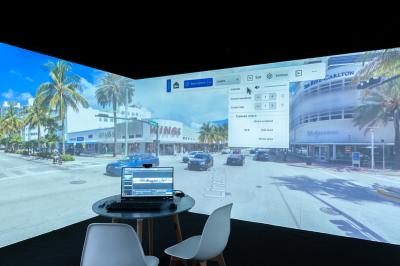
Our Software Platform for immersive spaces
4th September 2024
Virtual reality, or VR, is the latest technological advancement that immerses users in a simulated environment, which can replicate real-world settings…
For a long time, the future of work just meant smaller laptops and faster Wi-Fi. But as we move toward 2026, things are getting much more interesting. We are moving away from just staring at flat screens and starting to actually step inside our work.
At Igloo Vision, we’ve spent years building rooms that surround people with content. We’ve seen this technology grow from a cool gadget into a vital tool for big businesses. Looking ahead, the way we use these spaces is about to change in some very practical, exciting ways.
The biggest problem with immersive technology in the office has always been having to use a single headset per person. When you put on a headset, you’re cut off from the people sitting right next to you. It’s hard to have a real conversation when you can’t see your colleagues' faces.
We believe the future is about Shared Immersion. Imagine a meeting room where the walls are the screen, where instead of everyone wearing their own private headset, the entire team walks into a room that displays a 360-degree view of a project. You can point at a design, look your teammate in the eye, and discuss changes in real-time. It makes technology feel like a natural part of the conversation, rather than a barrier. This seems like a snapshot from the future, however this is already the reality with our immersive spaces.
While we are already seeing AI handle everyday tasks like writing emails, there is a strong possibility that its next big role will be helping us visualise our ideas in real-time. We could eventually see a shift where building complex 3D presentations manually becomes a thing of the past. Instead, we might get to a point where you can simply describe a concept to the room and have it appear around you.
In this scenario, you might imagine asking your office to "show the new factory layout with the updated machinery," with the walls potentially transforming to display that exact scene. If this development holds true, AI could act as a sort of digital stagehand. It would handle the technical setup of the environment so that teams can focus more on high-level decisions and less on the software behind the scenes - something we’re working towards in our latest software updates.
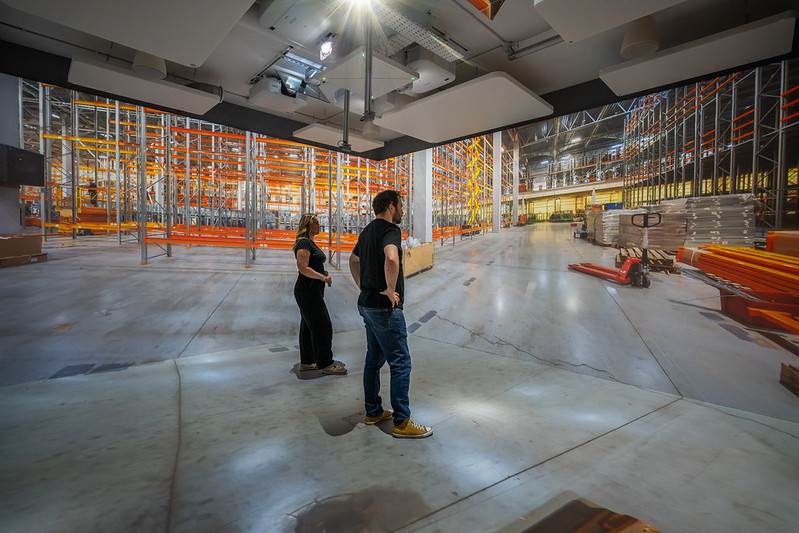
One of the most practical uses for immersive rooms is the "Digital Twin." This is essentially a perfect digital copy of a real-world place such as a construction site, a power plant, or a new retail store.
Instead of flying a whole team of executives or engineers across the country to check on a project's progress, they can just step into an Igloo. Because the room is life-sized, you get a true sense of scale that you just can’t get on a computer monitor. It saves a massive amount of time, travel costs, and carbon emissions, all while making sure everyone is literally on the same page. While this is already possible within our current simulation Igloos, we expect future developments to take this to an entirely new level of realism.
While our current Igloo immersive workspaces already help bridge the gap between remote and in-office teams, we expect the technology to move far beyond standard video conferencing. We already offer the ability to bring remotely located teams into the heart of the discussion with immersive video conferencing, where you can share multiple streams of content from different locations and devices all at the same time. This setup allows for a more natural face-to-face connection and ensures that everything needed for deliberation is clear for everyone in the room to see.
Looking forward, we anticipate this will evolve into an even more sophisticated spatial presence. We could see the rise of holographic-style projections that do not just show a flat image of a colleague, but a volumetric, 3D version of them that looks consistent from every angle in the room. This, combined with the possibility of AI-driven sensors that track eye contact and subtle body language, might one day make a digital meeting feel indistinguishable from being in the same physical space
Finally, these rooms aren't just for hard work; they’re for people. As companies focus more on employee burnout, immersive spaces are being used for digital resets.
When a room isn’t being used for a high-level meeting, it can be turned into a peaceful forest or a beach at sunset. Spending just ten minutes surrounded by nature, even digital nature, can help clear the mind and lower stress. It turns the office from a place where you just grind into a place that actually supports your well-being.
The future of work isn't a sci-fi movie; it's happening right now. From universities using these rooms to teach surgery to architecture firms using them to walk through buildings before they’re even built, the shift is already underway.
If you are interested in taking the first step into the future of technology today, then contact our team and we can advise you on the most suitable VR space.
 From watching to doing – how Sunderland College makes immersive learning interactive
 Design the experience, not just the content – lessons from UWTSD
 LASTING System and Igloo Vision sign an exclusive distribution agreement for Southeast Europe
 How Igloo helped deliver narrative gaming experiences at Sheffield DocFest
 How to Successfully Launch an Immersive Classroom in Higher Education
 Are immersive rooms easy to use?
Categories: Shared VR
4th September 2024
Virtual reality, or VR, is the latest technological advancement that immerses users in a simulated environment, which can replicate real-world settings…
4th April 2019
Igloo Vision, the leader in Shared VR and 360° immersive technology will be at VRXEurope in Amsterdam, on 10 and 11 April 2019.VRX Europe is …
17th November 2020
At Igloo HQ, we’re ever-so-happy to announce that, despite the continued challenges of the COVID-19 pandemic, the company has raised a further…