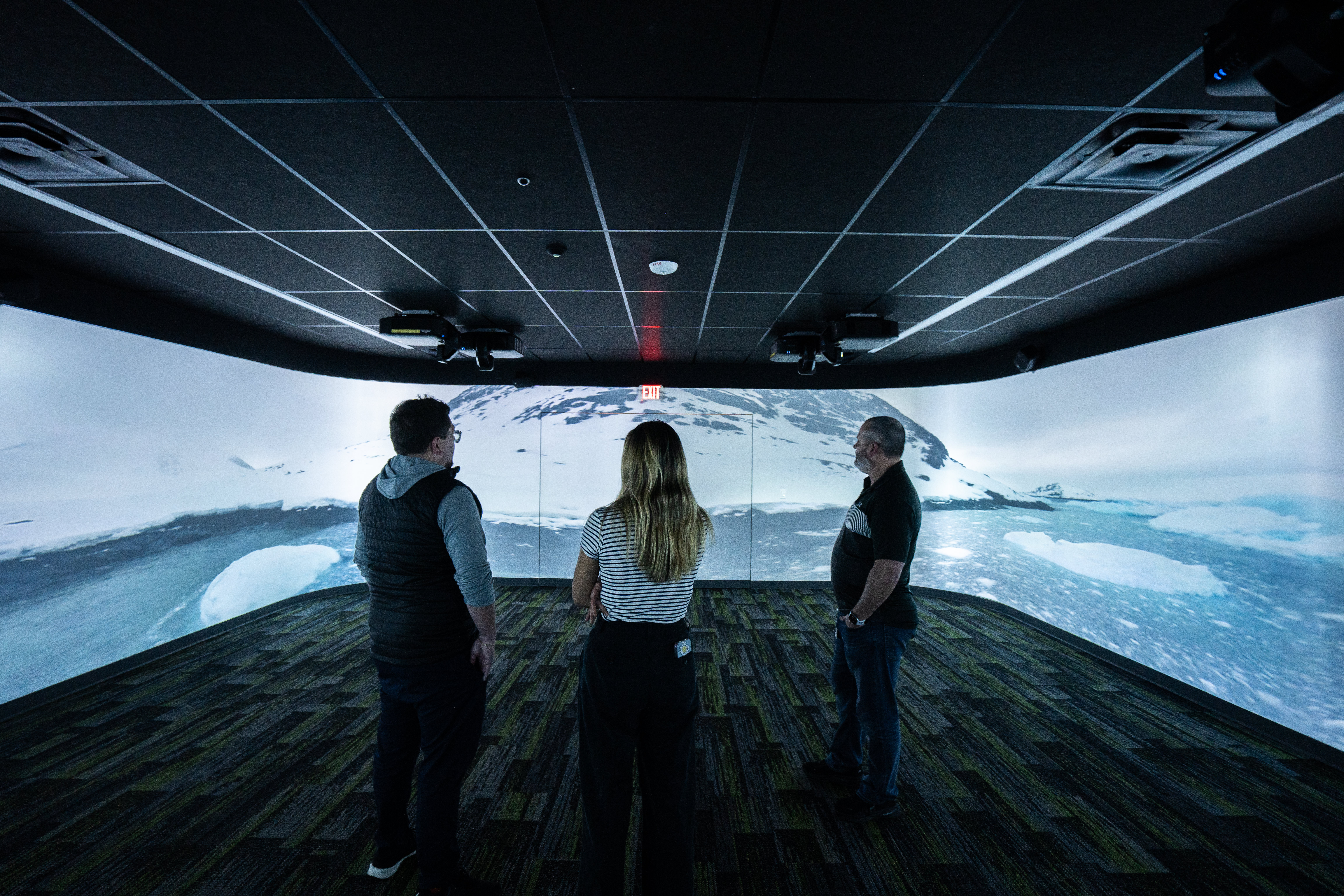
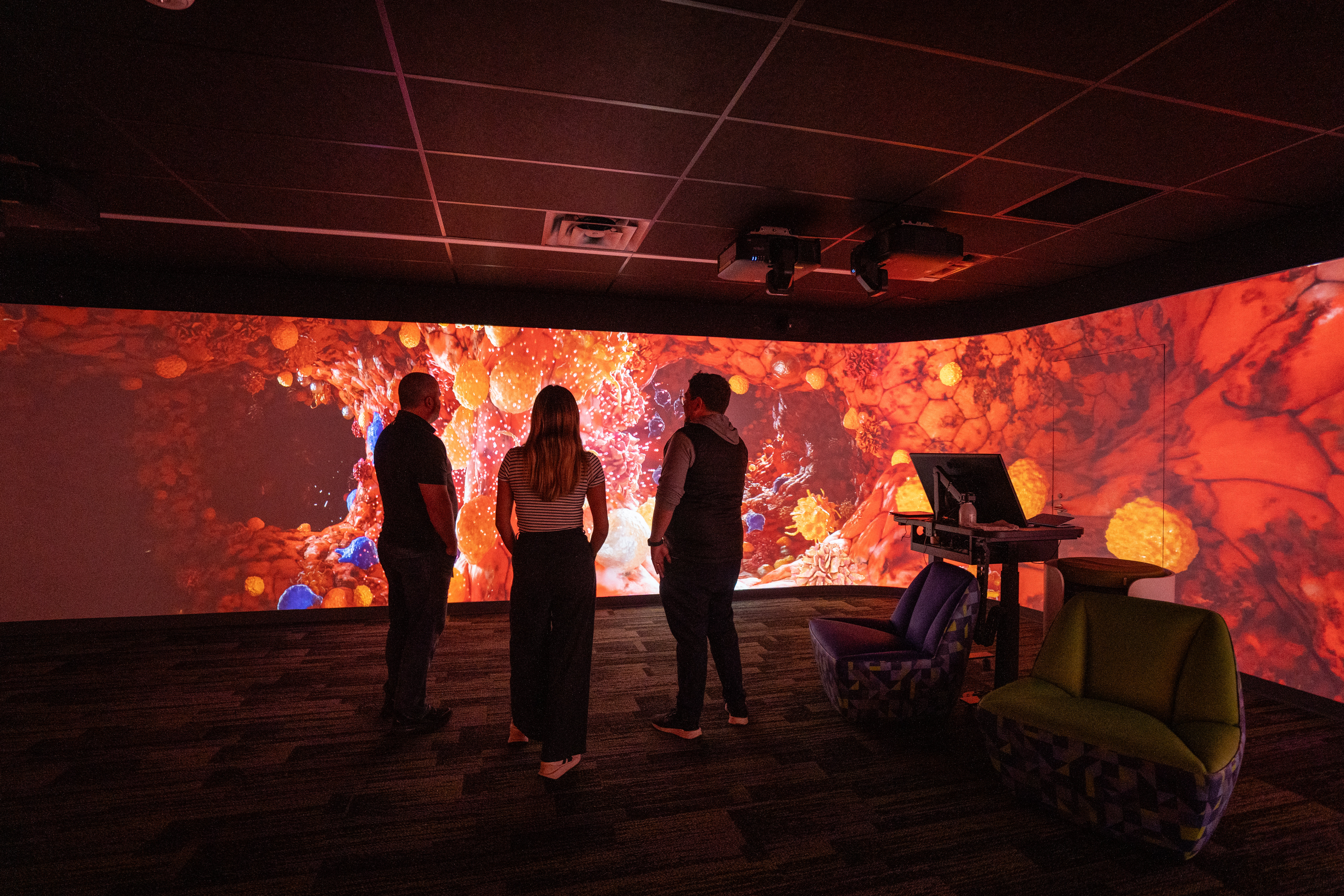
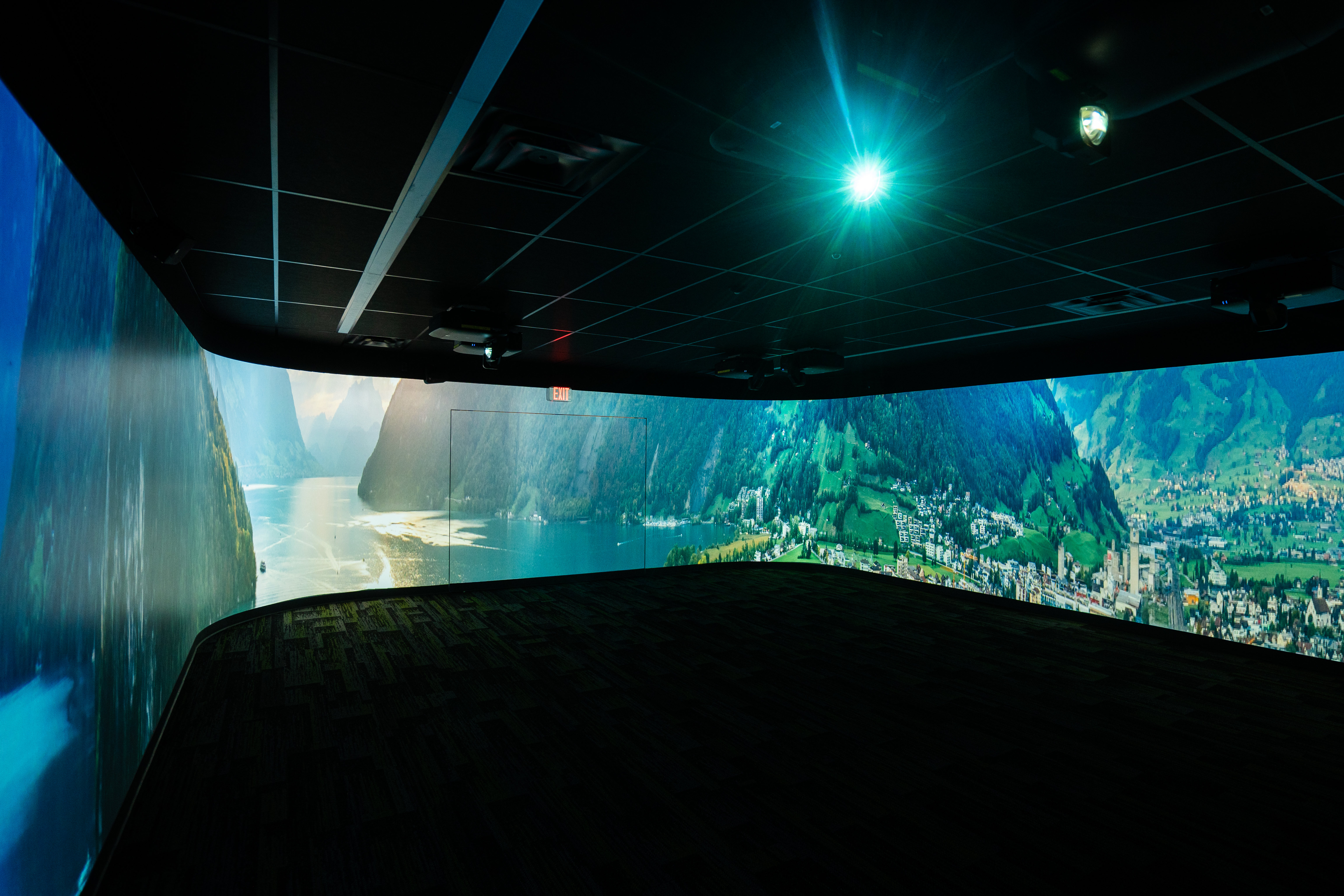
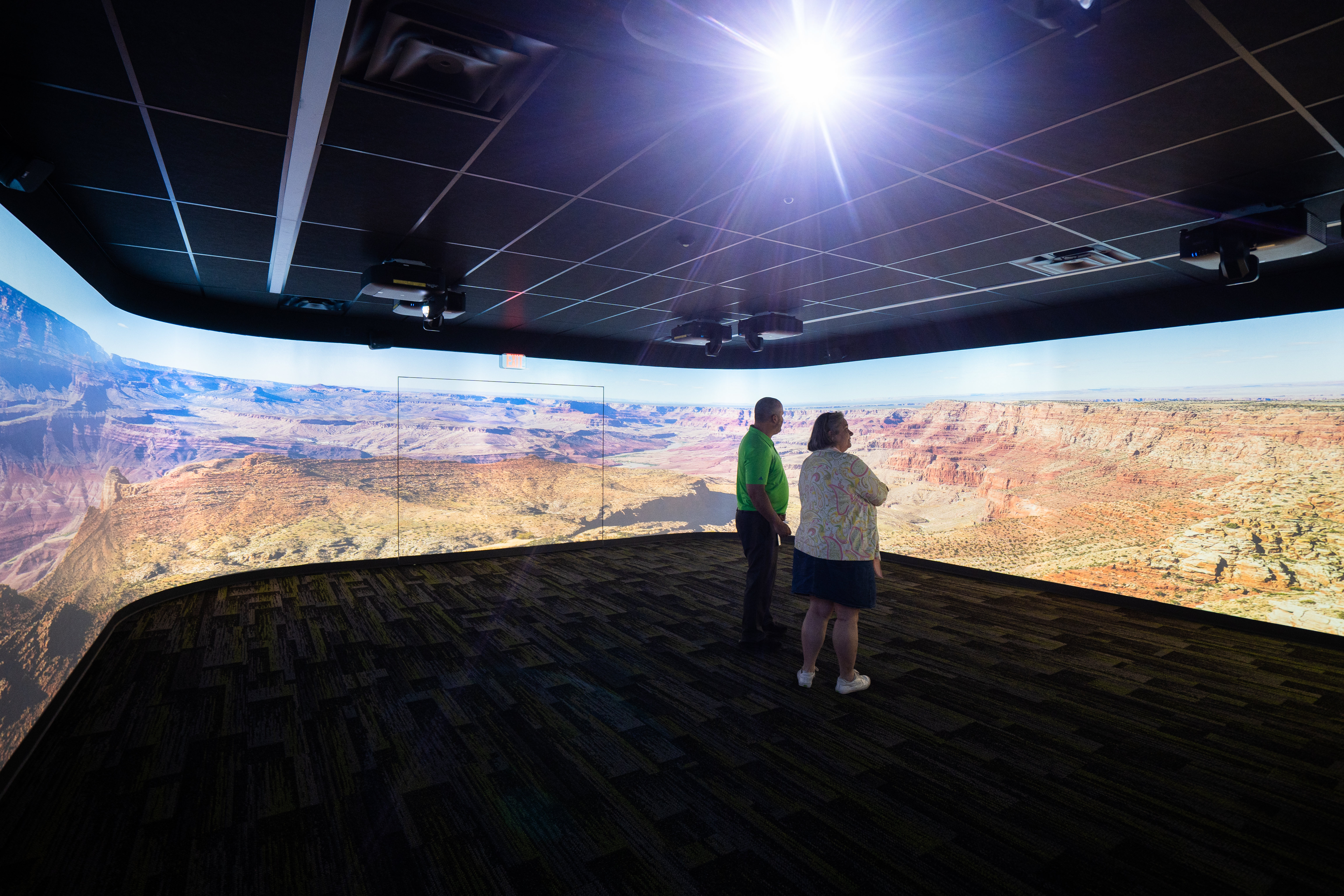
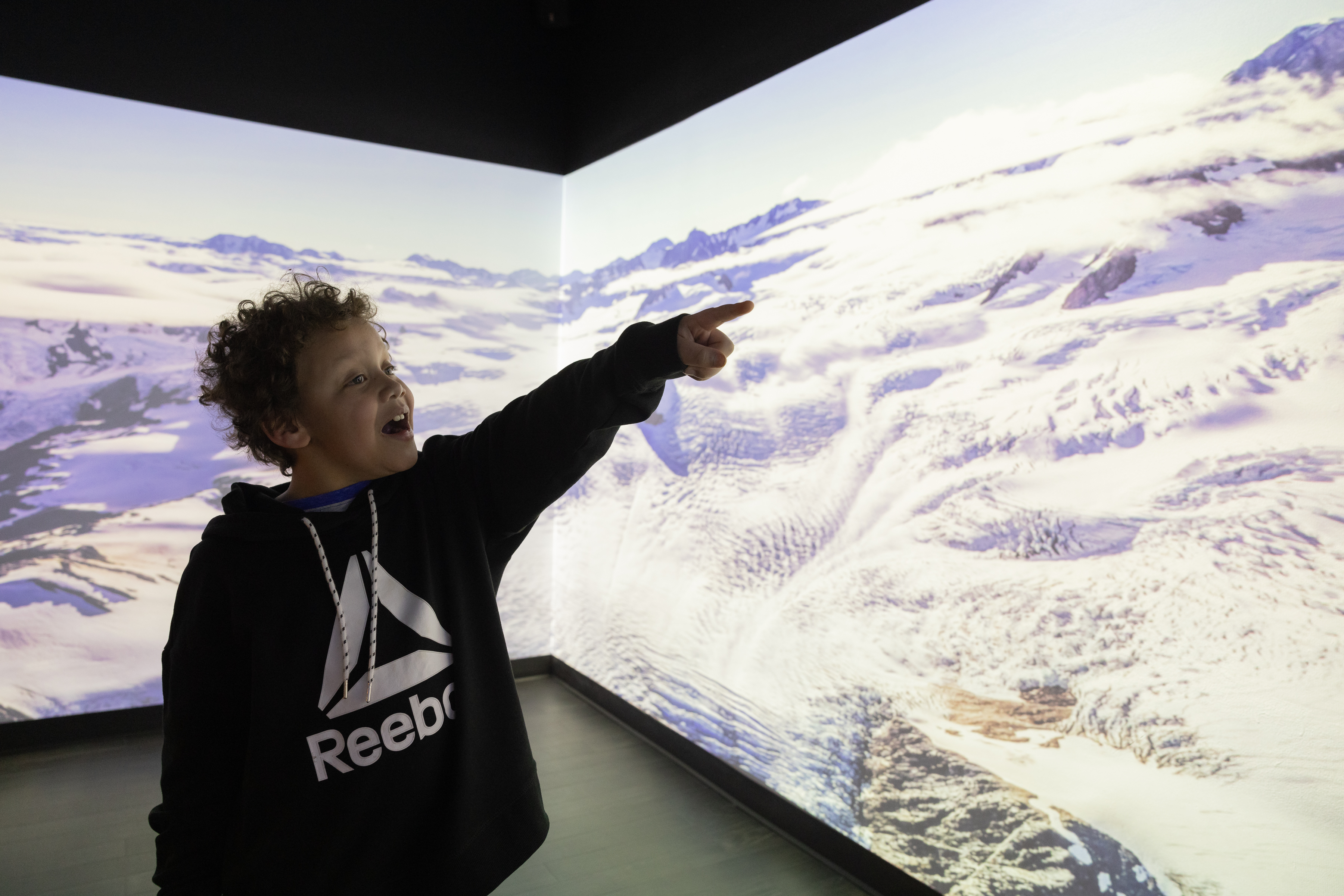
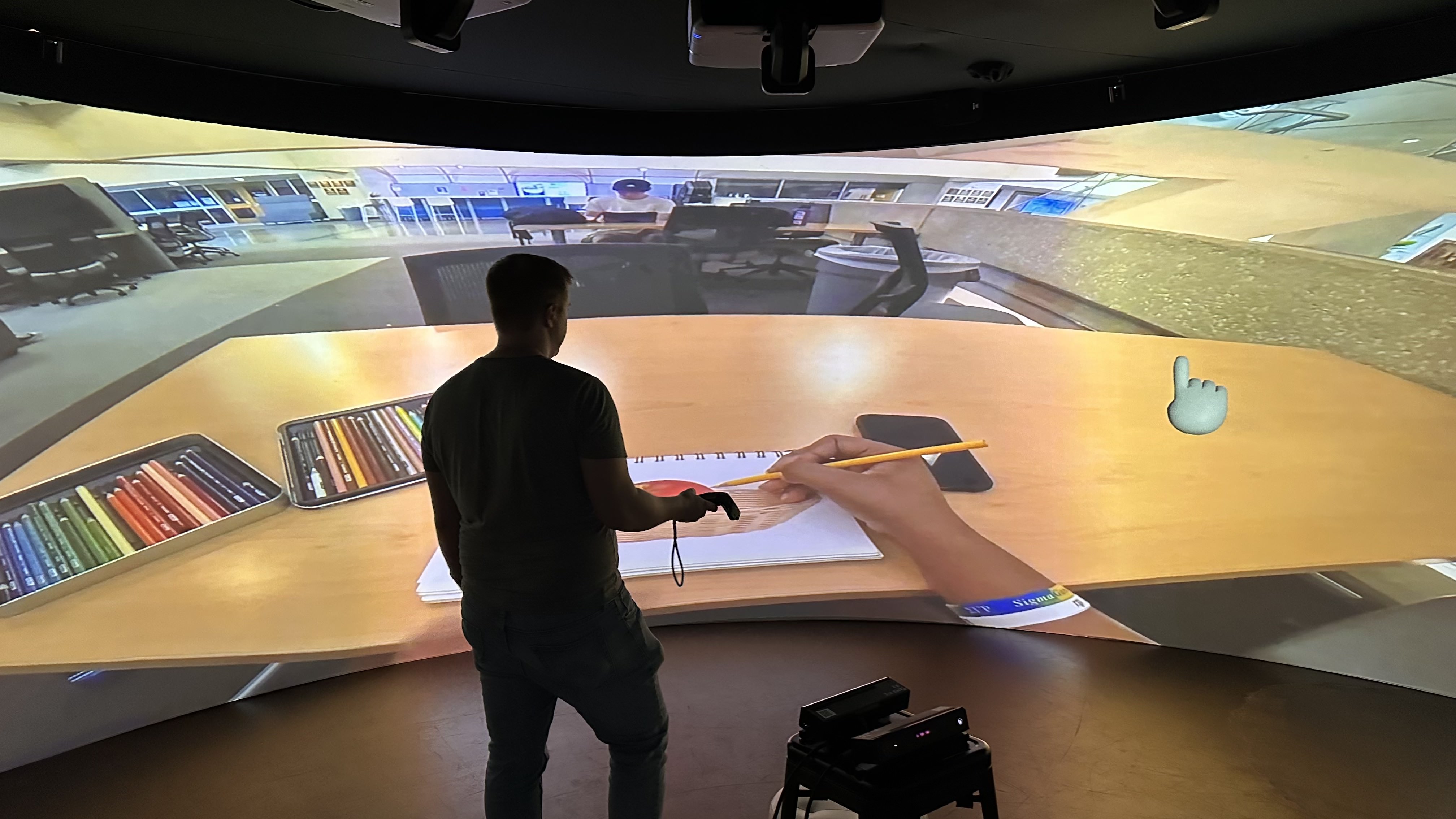
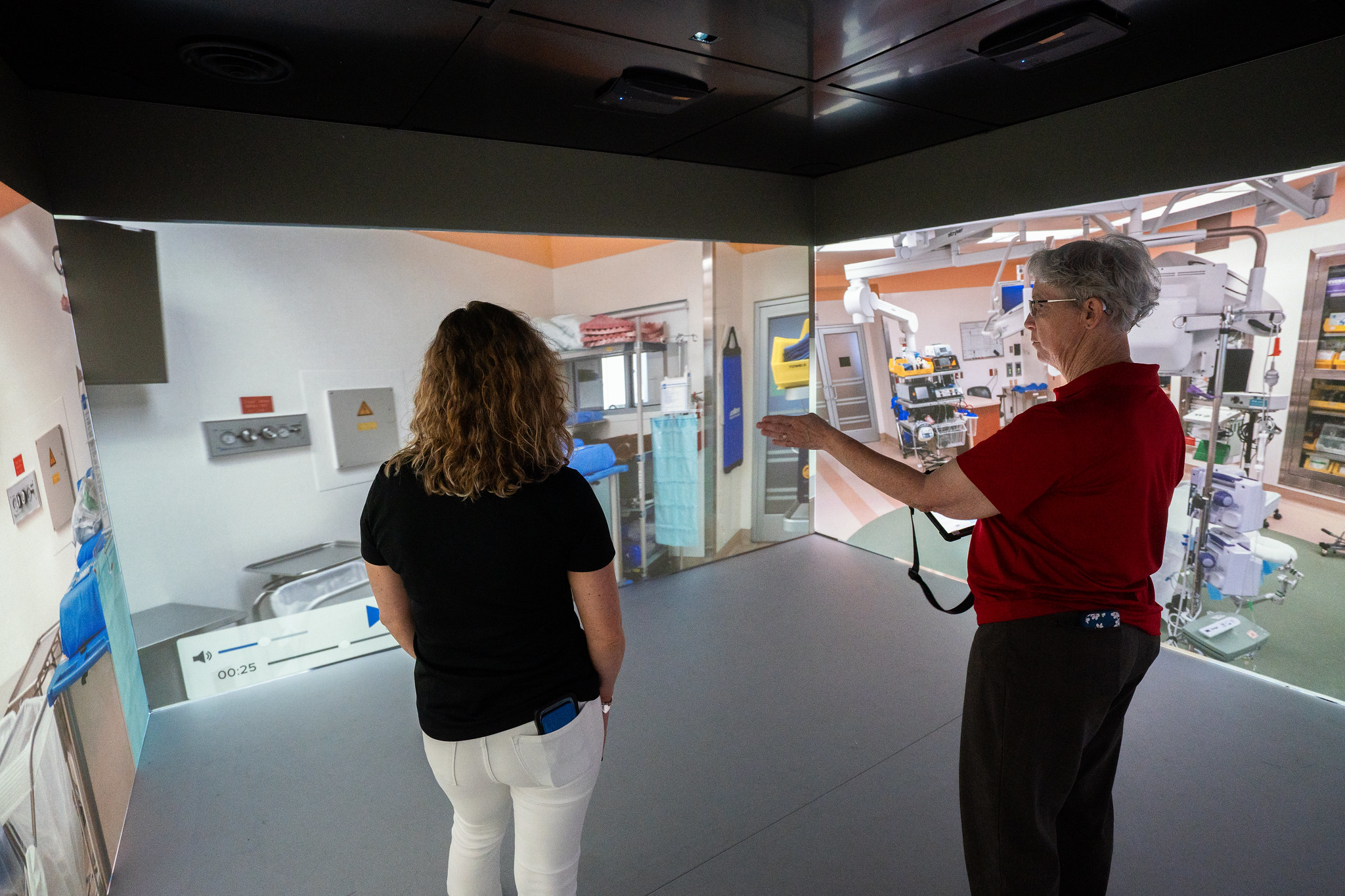
Hardware. The immersion studio sits within the STEM Exploration Center on the Berkner campus – a purpose-built facility that also houses a messy lab, a clean lab, and a training and lecture room. The studio is a large, fully enclosed 360-degree space. Eight projectors combine to create a seamless wraparound image across the walls, supported by 5.1 surround audio. The floor is carpeted, and the room is furnished with soft seating and a control podium.
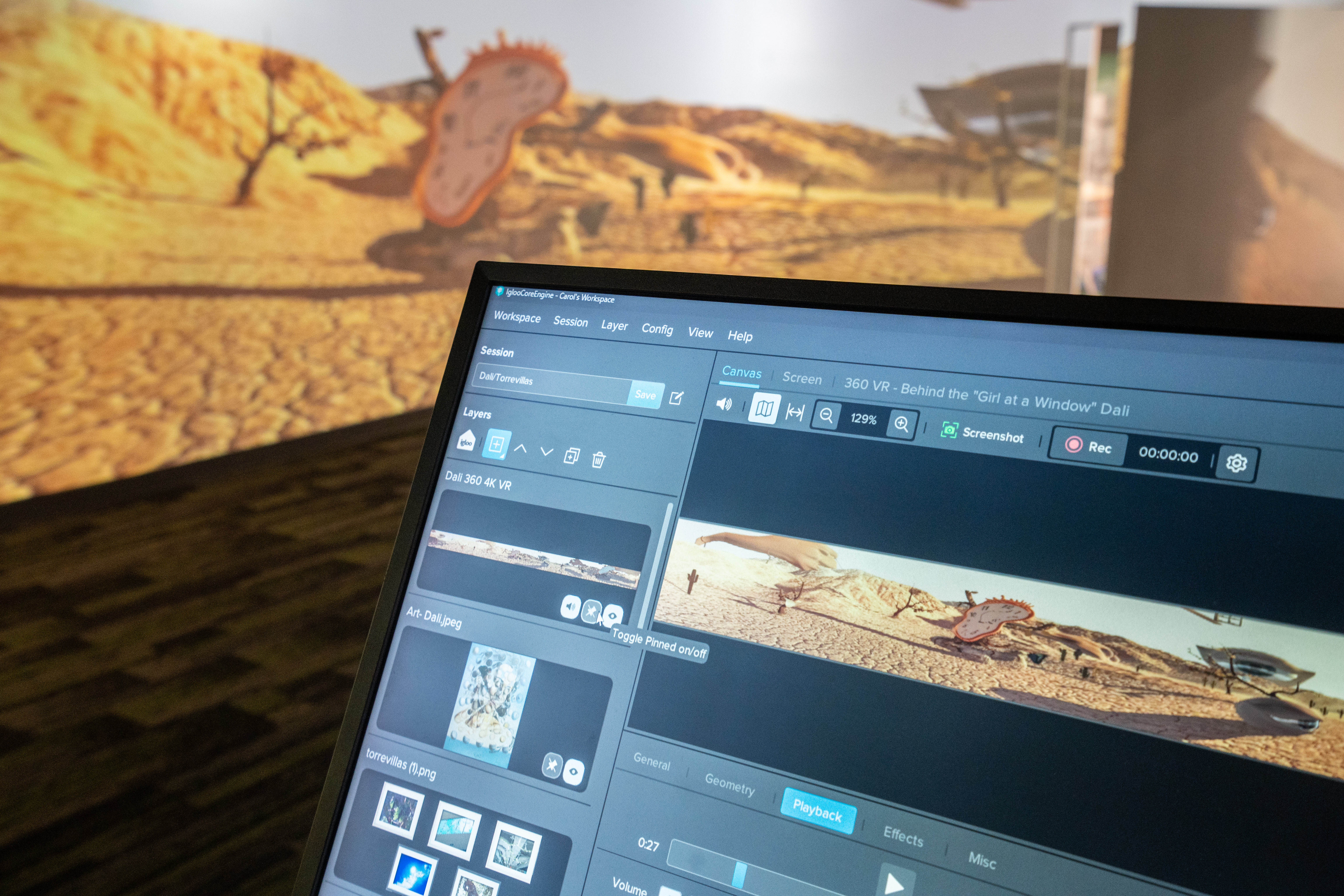
Software. The system runs on Igloo Core Engine, Igloo Vision's software platform for immersive spaces. Carol McBroom, the district's academic facilitator, manages content for the space. Her workflow is straightforward: she meets with a teacher in advance, takes a brief on their learning objectives, then sources or builds content to match. Teachers bring their groups in and lead the session, and Carol handles the technical side. The system is designed to be operated by anyone – no specialist training needed – and Carol has found it consistently reliable and easy to navigate.
Content. The team draws on a wide range of sources, most of them freely available. Matterport provides 3D scans of real-world locations, including places that are not accessible to the public – the interiors of ancient Egyptian tombs, for instance. YouTube 360 brings in video content from documentary producers around the world. Adobe Stock supplies 3D panoramic images. Google Maps puts any street-level location on earth within reach. Where existing content doesn't fit the need precisely, Carol uses AI image generation tools to build something from scratch.

"It provides a lot of options for us. It's very easy to use. Once you've learned it, you're able to find the content that you need and create all kinds of different learning experiences, depending on what your topic is."
Carol McBroom
Academic Facilitator, Richardson ISD
The immersion studio has always been busy. It’s not one of those investments that never took root. Seven years on, there's still a regular flow of groups coming through the doors. The booking calendar is managed across the district, with a dedicated bus bringing student groups in from other schools.
The range of uses has expanded steadily. Biology classes come to see a life-sized cell from the inside, and follow the session with a physical model-building exercise that the immersive experience gives genuine context to. History students step into a First World War trench before opening their textbooks. Art groups use the studio as a gallery, surrounding themselves with works they are studying. Students on a college-preparation programme called AVID – a long-established US scheme designed to help first-generation and underserved students reach higher education – take virtual tours of university campuses they may otherwise never visit in person, reducing the anxiety that can accompany the prospect of leaving home for college. Special education students have walked around a scale model of the solar system, moving between planets rather than looking at a diagram.
What runs through all of these uses is the same principle: the immersive room works best not as spectacle, but as context. Put students inside the material before the formal lesson begins, and the formal lesson lands harder.
For teachers, the effect is practical as much as it is motivational. The immersive room breaks the pattern of desk-and-presentation teaching without requiring teachers to rethink their entire lesson plan. Carol handles the setup; the teacher handles the pedagogy. Bringing a group in at the start of a unit to establish context – to give students a sense of what World War I felt like before they learn about its causes and consequences – is a straightforward shift that changes the quality of everything that comes after.
For the students themselves, the effect goes beyond the classroom. Many arrive not knowing what to expect. They leave talking about it – to their parents, to their friends, sometimes expressing a preference to attend Berkner High School specifically because of the immersion studio. And, given the backgrounds of many students in the district, the gap between classroom learning and real-world experience is one that no field trip budget could close.

"A lot of our students here in Richardson have never been to downtown Dallas and will never experience some of the things and some of the places that we put them in. It doesn't just make a learning impact on those students – it allows them to experience and feel like they're there."
Creighton Bryan
Executive Director of Career and Technical Education, Richardson ISD
Looking ahead, the priorities are straightforward. Carol’s focus is on getting even more students through the door – there are groups across the district who have not yet had access to the space, and widening that reach is her primary goal. The longer-term ambition is to embed the immersion studio earlier and more systematically into curriculum design: not as an occasional treat, but as the opening move in a unit of study, giving students the experiential foundation that makes everything that follows more effective.
Creighton’s view is shaped by the construction economics as much as the pedagogy. Building costs have risen sharply, and school districts are under sustained pressure to justify capital investment. His argument is that the immersion studio earns its place precisely because it was never treated as optional. It is used consistently, valued across age groups and subjects, and its impact extends beyond the students who pass through it – to parents who hear about it at home, to prospective students who choose Berkner partly because of it, and to the educators from other schools who arrive by bus hoping to give their own students the same experience.
In short, the case that Richardson ISD has made – quietly, over several years of consistent use – is that immersive learning works best when it is built-in from the start and treated as infrastructure, not innovation.
"They're surrounded by their content. It's everywhere around them, and it just helps them to kind of get a better feel for what they're learning."
Carol McBroom
Academic Facilitator, Richardson ISD
"Teachers love it. It provides them a new opportunity. It breaks up the monotony of the day to day – sitting in a desk, using a PowerPoint, getting a direct lecture. It allows students to get up, to interact with the teacher, to look around, to move. It just takes that regular teaching experience and levels it up a notch."
Creighton Bryan
Executive Director of Career and Technical Education, Richardson ISD
"Students don't remember their day to day. Students remember experiences."
Creighton Bryan
Executive Director of Career and Technical Education, Richardson ISD