


A Cave vs. an Igloo - how to choose the right tool for the right task
30th April 2019
There’s a common misunderstanding out there in the immersive technology market, and especially in the academic and research-related communities…
What truly makes an experience stick? Whether it’s a high-stakes training simulation or an inspiring educational session, the difference between “just another meeting” and a significant moment often comes down to 2 core aspects: immersion and connection.
At Igloo Vision, our immersive rooms and cylinders are designed to go beyond the individual. While VR headsets isolate, our shared immersive spaces bring people together; and there are scientific reasons as to why doing something as a part of a group is more powerful than solo.
Research in social psychology, most notably by Erica Boothby, has uncovered a phenomenon known as: The Amplification Effect.
In a landmark study, participants were asked to taste chocolate. Some tasted it alone, while others shared the experience with a partner. Even without speaking, those who shared the moment rated the chocolate as significantly more flavourful and enjoyable. Conversely, when the experience was unpleasant, the presence of another person made it feel even worse.
Sharing an experience doesn’t just make it better, it makes it more intense. When a team enters the Igloo cylinder for a 360-degree simulation, the collective focus acts as a psychological lens, sharpening the emotional impact and ensuring the “message” of the content is felt more deeply by everyone in the room.
Standard screens create a flat experience, where the user is an observer. Our immersive rooms, cubes, and cylinders wrap the content around the viewers, engaging their peripheral vision and removing external distractions. By providing a 360-degree experience, we engage the senses in a way that paper or 2D film simply cannot. This creates a sense of feeling like you are actually being inside the data, the location or the simulation. For industries like AECO (Architecture, Engineering, and Construction) or healthcare, this level of realism is the difference between seeing a plan and understanding a space/situation.
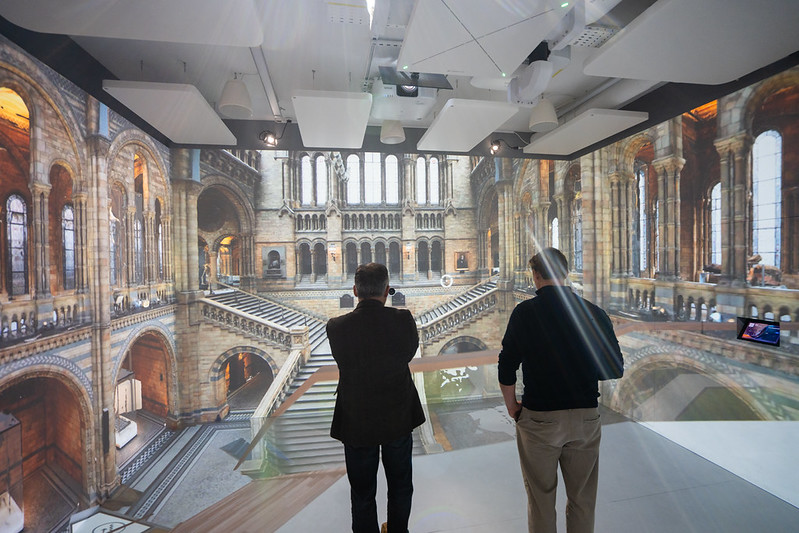
A core benefit of shared immersive technology is how it leverages the brain's "spatial memory.” We don’t just remember what we saw; we remember where we were when we saw it.
Because our immersive spaces allow for a real perspective and spatial dynamics, it enables the brain to encode information as a “lived event” rather than passively consumed information. When teams collaborate within these spaces, they develop transactive memory; a collective understanding where the group weaves the experience together. This leads to a much higher long-term retention rate compared to independent learning,
A powerful experience must be more than just a movie; it needs to be interactive. This is where our Igloo Core Engine software comes in.
Igloo Core Engine is the "brain" behind our cubes and cylinders, allowing you to:
Experiences aren't just about what you see; they’re about how you feel. By fostering a collaborative environment, Igloo immersive spaces ensure that every participant is on the same page, literally and figuratively. Whether you are fast-tracking recruitment, onboarding employees, or visualising complex data, doing it together in a shared immersive space ensures the impact is stronger, lasts longer, and drives better results.
Get in touch today to request a demo or to find out more about elevating your experiences.
 From watching to doing – how Sunderland College makes immersive learning interactive
 Design the experience, not just the content – lessons from UWTSD
 LASTING System and Igloo Vision sign an exclusive distribution agreement for Southeast Europe
 How Igloo helped deliver narrative gaming experiences at Sheffield DocFest
 How to Successfully Launch an Immersive Classroom in Higher Education
 Are immersive rooms easy to use?
Categories: Shared VR
30th April 2019
There’s a common misunderstanding out there in the immersive technology market, and especially in the academic and research-related communities…
20th August 2021
When our clients ask for something, we always listen. So when a number were asking for ways they could level up their pitch game using our immersive…

10th July 2025
When you think of immersive technology, you might picture VR headsets or futuristic gaming environments. But what if immersive experiences could …